Tokens From the Well

  • Travel
  • Creativity
  • Culture
  • Tech
  • Music
  • Contemporary Art
  • TheMWGallery.com

Featured Posts

These posts are featured front and center at the Tokens From the Well arts blog home page.

. . . And One More Thing About Sun Ra

January 31, 2017 By Matthew White Leave a Comment

FacebookShare

As discussed in a recent Brain Fuzz podcast episode with artist Michi Meko, I recently revisited Sun Ra for some reason. Probably because I’m rebooting my record collection and realized he wasn’t represented.

I couldn’t remember how the evolution of his music worked, so I decided to start again from the beginning. This proved tougher than expected – the discography is massive and disorganized. Recordings were made, then shelved for years in some cases, then released, then maybe released on another label and combined with another title.

What’s striking is just how the early work fits nicely into jazz sub-genres like bop or swing. The early Supersonic Jazz and Sound of Joy are enjoyable simply as jazz records.

Sun Ra - Space Is The Place

Sun Ra as he appears on album cover of Space Is The Place.

I say simply, because something noticeable happens with Nubians of Plutonia – a new favorite of mine. The emphasis shifts to experimentation, and from there, the listening gets more complicated. Cosmic Tones for Mental Therapy is downright difficult – the seemingly devil-may-care approach coupled with percussion at the forefront makes for tough going, even on repeat listens.

By the time of Atlantis and later, Space Is The Place, Sun Ra has struck a balance between the avant garde and the approachable.

Is Space The Place?

But of course, approachable is far from accessible. It’s tough to connect the cosmic and demonic references in the titles of even the earlier, more traditional jazz works. And at first glance, it just gets stranger from there.

For most potential listeners, the Sun Ra persona is a barrier. In the past, I lumped the costumes and the language all in neatly as “Afrofuturism,” mainly because it was easy to label and move on and, hey it’s just weird and maybe even nonsense.

In actuality, there’s much more to it. Spoiler alert: Space isn’t the place after all.

. . . And that is why you should not only listen to Sun Ra, but check out our Brain Fuzz arts podcast episode with Michi Meko for unique insights on Afrofuturism, altered destiny, and persona.

FacebookShare

Filed Under: Featured, Music Tagged With: Creativity, Music

Eastbound and Up: Nashville (Part 2)

October 9, 2016 By Matthew White Leave a Comment

FacebookShare

Whenever you see the words “art district” be wary.

Why? Governments aren’t good at identifying the best art districts for your time and money. Crime statistics, however, are better indicators. Go out and see for yourself. I could elaborate, but it’s beyond the scope of this blog entry.

One of the main reasons for visiting Nashville this time were stops in the Nashville Arcade. The spaces are great. But, unfortunately, the memo about being open 11a-3p on Saturdays ended up in the spam folder. As discussed in an episode of the Brain Fuzz arts podcast, engagement – the dead horse that artists and arts administrators continue to whip – requires that 1) the door be unlocked when you say it will be unlocked and 2) the phone be answered.

So much for those “art district” signs.

The Biscuit or The Gravy?

East nasty biscuit at Biscuit Love in Nashville - a recommended travel stop

An East Nasty at Biscuit Love in Nashville. Bring your own defibrillator.

There is good news, however.  As explained in part one of this Nashville travel exposé I was unclear on hot chicken’s origin story. Biscuits on the other hand, I understand their origin story better. And, one place that is not overhyped in the Gulch is Biscuit Love. All of the development in the Gulch can be off putting. To see a line of fifteen or twenty deep there is not unusual. What is unusual however is the phrase “East Nasty” – a biscuit with chicken, cheddar, and gravy.

WeHo

With a full stomach of hangover food, you can head on over to two of the best gallery spaces in the south. Zeitgeist and David Lusk Gallery are comfortably located side by side in Wedgewood. These two spaces are always on the Nashville list. Nearby is Fort Houston – a real world working model of what a creative co-working space can be. It’s pretty awesome. I did not see an “art district” sign.

In so many parts of Nashville, you find the real world authenticity that is hard to reconcile with the overhype and escalated development that the city is experiencing. It’s much like the difference between the Nashville of the 2010 floods and the Nashville of the 2016 gas shortage. For a while, you can still get that sense among the Wedgewood area stops.

The Backwash

On a grocery trip / ice run in East Nashville, we were met with this response in trying to locate bagged ice:

“Yes, but it’s spring water sourced. Is that OK?”

When your soakage will be an East Nasty, it will work.

FacebookShare

Filed Under: Contemporary Art, Featured, Travel Tagged With: Contemporary Art, Nashville, Southern Culture, Travel

Brain Fuzz: The Podcast

September 15, 2016 By Matthew White Leave a Comment

FacebookShare

I’m lucky to call Joe Camoosa a friend. He’s also a great painter. I would say artist, but he doesn’t like being called an artist. (You’ll have to ask him.) So, I’m almost always at a loss as to how I can best describe him.

Brain Fuzz - Art, Music, and Culture Podcast

If you love Tokens From The Well, you’ll at least really like Brain Fuzz. Maybe you’ll love it. And vice versa.

Going back almost a year, and at the urging of more than one other person, he and I started thinking about a podcast. We started recording conversations with no agenda or outline.  They were surprisingly cogent. They were also surprisingly coherent and relevant (at least to us).

Then, we started to structure our conversations a bit more. We still allowed for the randomness and variety that makes like interesting, and it all works somehow.

Topics include the creative life, studios, exhibitions, galleries, art travel, music, books, bands, various audiophiliac concerns, and related (or unrelated) minutiae. We typically avoid politics, religion, and sports.

Listen to Brain Fuzz sometime. And better yet, subscribe.

If you like Tokens From The Well, you’ll love Brain Fuzz – the new art, music, and culture podcast. I take that back. Regardless of whether you love Tokens From The Well or not, you’ll probably like Brain Fuzz.

Either way, give it a listen.

FacebookShare

Filed Under: Creativity, Featured Tagged With: Contemporary Art, Creativity, Music, Streaming, Studios, Technology

Eastbound and Up: Nashville (Part 1)

July 5, 2016 By Matthew White Leave a Comment

FacebookShare

“Smells like Bonaroo, tastes like heaven,” said the barkeep at The Pharmacy, regarding their Etienne Dupont Cidre Bouche Brut de Normandie. Neither one of us knew quite what to think about that assessment, but I can attest to the claims regarding their burgers probably being the best in Nashville.

Bar at The Pharmacy in Nashville

The burger at The Pharmacy might actually be the best in Nashville.

We were between stops on our first day back after a few months away, sandwiched between settling in our E. Nashville Airbnb and hitting a vinyl shop.

The afternoon’s itinerary also included a stop at a certain coffee shop where you can admire the artisan style iPad point-of-sale while trying to decide if you’re in a line or not (and for what). There, you have ample time to admire Metric on their turntable setup as you wait for your order to be called out.

Also, they have coffee.

I’ve had a similar experience while seeking caffeine there before. A friend’s recent account of his visit was surprisingly similar down to bus cart confusion. I still couldn’t locate the bus cart.

They also have several hot teas.

Eastbound and Up

One could easily stay in East Nashville and never go downtown, or anywhere else for that matter. Still Nashville has so many evolving neighborhoods that would be must stop destinations in any city. Grimey’s is truly a one-of-a-kind music store with a fine venue right under it in The Basement. That’s worth leaving East Nashville for. But, they’ve got a sister – or brother – venue with the Basement East in, you guessed it, East Nashville.

Black Mountain at Mercy Lounge in Nashville

Black Mountain at Mercy Lounge in Nashville.

Closer to downtown, you’ve got Mercy Lounge and The Cannery Ballroom. The history alone regarding these Cannery Row venues is surprising. Speaking of history, there’s of course the Ryman. And, yes, the acoustics really are what they say they are.

Most of these stops have histories before the development boom of the last ten or fifteen years in Nashville. This boom has brought an almost overwhelming number of destinations for foodies and those with high credit limits and levels of disposable income. At the time of writing, roughly $2 billion in building projects across the area are underway.

What’s fueling the development? I hate to say it, but it looks like it might actually be as simple as a concerted shift in urban design combined with an effort to attract business (read: employers) to the city. Area industry has been lauded as more diversified (read: it’s not just country music) than that of other cities. It’s a college town. It’s a sports town.

In short, it could be a poster child for what loose monetary policy is supposed to do everywhere.

Some Potentially Related – or Tangential – Facts About Nashville

  • Music City Waste, NashvilleLike Florida, Tennessee has no income tax.
  • Nashville is a pain to fly into without a private jet.
  • Hotel rooms are few, and a Hampton Inn might cost as much as $400 per night.
  • Uber is a very effective method of transportation there.
  • Carter Vintage Guitars is better than Gruhn Guitars, but don’t tell anyone.

What’s The Origin Story of Hot Chicken?

The demon spawn of tourism and loose monetary policy includes hype. In this case, the show Nashville can also be counted. And then there’s hot chicken.

Being southern, I had never heard of what has been hailed as a uniquely southern dish. Then, on a recent trip to Nashville, I found that it couldn’t be avoided. Like the author in a Bitter Southerner account, I didn’t understand where it came from or how I had missed it.

And, just as in the story from The Bitter Southerner, I made a similar discovery regarding it’s origin story when I asked an Uber driver about it.

Fried chickenHe said he and his brother would be roused when their father needed soakage around 2 am. But no, he said, it was never as big of a deal as it is now. It was just a thing in the black community.

I asked another Uber driver, and he said the best hot chicken was in East Nashville, contrary to countless reviews of tourist traps. I did see the phrase “Spicy Chicken” on an old storefront window and a telephone number without an area code.

I don’t know the difference between spicy chicken and hot chicken, but I did get a Gulch restaurant to bastardize (read: improve) one of their dishes with hot (or spicy) chicken. It worked.

Anyway, you can get Nashville Hot Chicken at KFC now.

In the next post, we’ll continue our survey of Nashville including a look in on the arts and a trip for bagged ice.

FacebookShare

Filed Under: Featured, Travel Tagged With: Food, Music, Southern Culture, Travel

Asheville: Portlandia of the East

April 7, 2016 By Matthew White Leave a Comment

FacebookShare
Moog Asheville

Outside the Moog store and factory in Asheville, NC.

With just a few minutes before our tour of the Moog factory, it was decided that a drink was in order. Luckily, a quick survey of the vinyl and guitar shops on N. Lexington also yielded a bar with afternoon hours.

A Symbiotic Colony

Maybe you’ve had kombucha. The thought of different species in a “symbiotic colony” is a little much for some. The reminder of that colony in a sometimes gooey or lichenous form is too much for others. Anyway, those taps weren’t beer taps. And, it was delicious. Buchi – local to Asheville – is delightfully effervescent on draft, and it is served without the lichenous surprises at the bottom.

Beautiful, Wonderful, and Handmade Things

People making things in America.

People making things in America.

It was with effervescent delight that we kicked off the visit to Moog headquarters. Yes, there’s a store there. More importantly, there are Americans actually building things at Moog.

And, they are beautiful, wonderful, and important things: Electronic musical instruments.

Job creation: Graffiti seen inside Moog.

Job creation: Graffiti seen inside Moog.

I could go on for hours about Moog. Thanks to Bob Moog and the Moog brand, we have music as we’ve known it since the 60’s: The sonic climax in “Lucky Man,” important chunks of Sun Ra’s flavor of Afrofuturism, countless themes and sound effects. Dubstep. The reason that “Here Comes The Sun” sounds different than other Beatles songs.

And still, they make these instruments by hand in Asheville. On this particular day, clouds were literally over the factory, but inside, there was another cloud – that of the loss of another music icon, Keith Emerson.

History and Perspective

Back at the Grove Park Inn – I’m sorry, the Omni Grove Park – the evening was already in full swing with the ever-present music of the Great Hall. Smaller halls feature portraits of distinguished guests, annually selected. Some years were apparently bigger than others – I spotted both Eleanor Roosevelt and Richard Simmons.

Black Mountain College Museum awning in Asheville

Outside Black Mountain College Museum in Downtown Asheville.

Later that night I tried to explain to an Uber driver that our view was over the entrance/exit for the parking garage. She tried to convince me that this was F. Scott Fitzgerald’s favorite spot, so that he could monitor the comings and goings of the guests.

I must have had the wrong parking deck.

Creative Community

Black Mountain College studies building outside Asheville

Beside what was once the Black Mountain College studies building.

The centerpiece of this trip with Atlanta Contemporary donors was to explore the story and site of Black Mountain College. Atlanta Contemporary makes guided trips like this available to its donors, and these excursions provide unique experiences with sights and stories you might otherwise miss. Like a trip to Hale County, Alabama that we took some time ago.

In today’s era of academic inflation, Black Mountain College is an almost unbelievable story: Some of the world’s greatest creative minds of the 20th century congregated just east of Asheville in an effort to explore new ways of learning and creating.

Dining Hall at Black Mountain College

Merce Cunningham and John Cage gigged here: The dining hall at Black Mountain College today.

On top of that, they actually had some graduates.

Two Views of the Past

Black Mountain College hosted the likes of Robert Rauschenberg, Willem De Kooning, Josef Albers, John Cage, Merce Cunningham, Buckminster Fuller, and dozens of others during its time.

The story is kept alive in downtown Asheville by Black Mountain College Museum + Arts Center. They show Black Mountain College related work as well as house a collection. In addition, the Asheville Art Museum houses works by Black Mountain College artists, and they highlight them in their exhibitions.

Paint Spots on Floor

Paint drippings remain in one studio at the former campus of Black Mountain College.

Meanwhile at the actual site on Lake Eden, about twenty minutes east, the former studies building stands as a stark reminder of the school’s role in shaping countless creative paths.

Other structures remain. There’s the dining hall, where the residents put on plays and performances. Beneath the studies building, two frescoes by Jean Charlot are weathered, but still visible.

The campus is now home to a kids’ camp. I’ve read a few accounts regarding the experience there. It was intimate. It was experimental. It was hippie dippy before its time. Being part of the community actually required labor, sacrifice, and personal investment.

Fresco by Jean Charlot

“Knowledge” – part one of the now faint and weathered frescoes by Jean Charlot.

Having the opportunity to walk the campus now, you get the distinct feeling that life would not have been easy by our standards at all.

But, there would have been a spirit, a creative drive, that would keep the residents moving forward in their purpose. What is that? What does it look and feel like? Where are the Black Mountain Colleges of our day?

They’re out there. Or are they?

Further Fermentation

Inspiration fresco by Jean Charlot

“Inspiration” – part two in the Jean Charlot frescoes, painted in the summer of 1944.

Sure, the arts are alive in Asheville, but right now, beer is the bigger draw. Fun fact: Asheville has more breweries per capita than any other city in the US. But, if kombucha or beer isn’t your thing, there are any number of drinking and dining establishments from moonshine cocktails to sunset cocktails. Then, there’s The Crow & Quill, membership required.

And there are the handmade goods. Amid the sound of a distant drum circle, you can shop for any handmade leathergoods you might require. While waiting for brunch, you too can discover a fantastic shop with vintage belt buckles and handmade wallets, keychains, belts, and checkbooks. Which is nice. It’s real, man. And it’s there waiting for you.

Meanwhile if you find another kombucha bar or an artisan knot shop, let me know.

mountain view near Asheville

The view from Lake Eden at Black Mountain College.

FacebookShare

Filed Under: Featured, Travel Tagged With: Art, Creativity, Culture, Food, Travel

Who Is The Cross Disciplinary Artist? (Part 1)

March 17, 2016 By Matthew White 2 Comments

FacebookShare

While on a tour of the Asheville Art Museum, our guide stopped at a piece.

“And this is one of the many examples of outsider art we house here.”

That phrase again. The usual discussion ensued regarding what it means to be an outsider.

As a cross disciplinary artist, maybe the term has a particularly sour ring for me. Still, I’ve been in and around the art world enough to know that while there are actually insiders, there are countless cliques within the clique before you get to the real inside. I’ll remind you that the aforementioned exchange did not occur at The Met, for example.

So it’s like an onion but often much smellier. And with more tears.

One Man’s Insider Is Another Man’s Outsider

After all, for most people, artists are outsiders. They’ve been perceived as being on the fringes of society for years. That probably shouldn’t be the case. In the interests of innovation, there is a role for art making – or at least a better appreciation of the creative process – across various industries. And similarly, the art world itself benefits when outside perspectives band together for a common cause. Think of the boards that govern countless arts organizations.

Regardless, there are art world luminaries who remain critical of some who decide to call themselves artists. For these luminaries and tastemakers, those artists are not to be considered artists or at least serious artists, because they do not meet certain criteria.

The problem is that a democratization of art making, appreciation, and criticism has been underway during the last two decades. More about that later.

Artist Criteria . . . Or, Disqualifying Criteria

Henry Darger Collage

Henry Darger, a textbook example of an “outsider artist,” could also be tagged as a custodian and recluse.

The requirements to be an artist differ from person to person. However, disqualifying characteristics tend to reside in these general categories:

  1. Lack of formal arts education.
  2. Employment outside of an art practice.
  3. Professional or financial success outside of the art world that funds an art practice.

Resulting debate on each of the above points is spirited.

Actively Accepted Artist Labels

Often, in an effort to settle the resulting debate or at least suspend the issue diplomatically, other terminology is employed. One may encounter any of the following generally accepted labels:

  • Sunday Painter – Those not in the art world know may be unaware just how derogatory this term is understood to be.
  • Hobbyist – Practically the same as not an artist or not a serious artist.
  • Outsider Artist – Though folk artists such as Howard Finster are included in this group, so are the clinically insane who “happen” to make art. This is not a joke. The term was coined by Jean Dubuffet in what was probably a genuine effort to embrace creative works made without generally recognized art world exposure or its confines.
  • Self-Taught – Essentially a sub-category of outsider artist.
  • Naive Art – Essentially a sub-category of outsider art. For whatever reason, you may view a group exhibition of naive art, but you will be less likely to see someone referenced as a naive artist.

A great book on the subject of the outsider, self-taught, and naive genres is . . . wait for it . . . Outsider Art: Spontaneous Alternatives by Colin Rhodes.

Artists in Boxes

If I search for David Byrne’s Rei Momo on Amazon, I discover that I can find it in the following categories: Alternative Rock, Jazz Fusion, Pop, Rock, and World Music. In the days when I could have bought Rei Momo at a brick and mortar record shop, I would have been most likely to find it in the Rock section.

David Byrne also produces visual work – not just music. So, today, if I go to David Byrne’s website, I can peruse the Art and Books section. He also happens to have a Film and Theater section. Now, tell me: Who is David Byrne? What does he do?

The reality is that the ways in which we process information have changed dramatically – and quickly – thanks largely to rapid advances in communication technologies. Yes, we’re speaking in broad terms about the Internet, mobile devices, and social media.

How Music Works by David Byrne

Book by singer, photographer, songwriter, artist, as well as actor David Byrne.

As a result of the influx of information, we as humans are discovering that the concept of tags often works better than the concept of categories. Categories worked pretty well once in the record shop. Now, categories are still helpful, but tags help our brains filter out all the results from the expanded number of information channels.

And not only do we process information differently, we (including David Byrne) also learn a lot differently – and faster – than we used to.

Think about it: Now more than ever before, because of those technological advances impacting both communications and productivity, people like David Byrne can be both defined and identified by more than a handful of experiential characteristics or properties.

And that’s where we get to the first big sticking point: Education.

More about education in Part 2 of Who is The Cross Disciplinary Artist? . . . 

Updated March 17, 2016.

FacebookShare

Filed Under: Contemporary Art, Creativity, Culture, Featured Tagged With: Art, Contemporary Art, Creativity, Outsider Art

The Continuing Crisis in Contemporary Art: Art Auctions

February 25, 2016 By Matthew White Leave a Comment

FacebookShare

Across the spectrum of artists, gallerists, curators, and arts administrators, there are few issues as divisive as that of art auctions for non-profits. It seems innocuous enough, right? Art auctions are a popular way to generate funds and public awareness for non-profit arts organizations. For many of those organizations, an auction may in fact be the primary driver for annual funding.

In addition to the non-profits, art auctions can be beneficial to multiple parties in a number of ways:

  • Budding collectors benefit by building their young collections.
  • Artists get exposure.
  • Galleries representing participating artists have an opportunity for exposure.

But, Some Say There’s a Rub . . .

The Continuing Crisis in Contemporary ArtDetractors however claim that these events have a number of negative unintended effects:

  • Art auctions drive prices down, hurting both artists and galleries.
  • Collectors get “inferior” work, because contributions may be of lesser value.
  • Galleries suffer, because buyers may choose to do their buying at auctions.

Then, there’s the argument that prices paid at art auctions reflect the “real” market prices. I’m no economist. But, let’s think about this a moment: Getting any base of buyers together to bid on a pool of desired goods is one of the purest ways to determine the real value of those goods. Think eBay. Or, a stock market (without a Plunge Protection Team).

The biggest negative I see is when the highest bidders don’t properly pack their booty and, after a few pinots, cram it into the back of a smart car.

Lopping Off an Olive Branch

Donations to non-profits or charity have the most impact when they involve sacrifice of resources, whether time or money. For many of us, donations have come to be identified as the used items we pack up for Goodwill.

It all calls to mind the gently used underwear donations that were actually made famous by talk show hosts some years ago. True, some artists use art auctions as opportunities to get rid of works (and maybe underthings) that clutter the studio. But, any discerning buyer or collector should be able to spot this. Otherwise, if a budding collector likes the work, and it hasn’t sold after ample opportunity, so what?

Still, there’s a better solution – or several of them in fact – for all parties.

Experiences

In the least criticized category, some organizations auction off experiences with artists, curators, and other community members. These often involve alcohol, some art, and they might happen in another city. If non-profits are seeing the “quality” of donated work decline, this might be the best option of all. Clearly, there are gains in promotion and visibility for all parties.

Exclusive Artwork

If works are specifically created for an art auction, such as a piece that will not be part of a larger series, nobody really gets hurt. The collector gets a unique piece. The artist and her gallerist both get exposure.

Studies

Or, the work might be speculative in nature, exploring new creative paths or mediums, such as a study for future work.

In the interests of both full disclosure and promotion, the works that I’ve donated in full for the ART PAPERS Art Auction have been completed around the time of donation, and they are in response to current trends. In these cases, the works have been an exploration of potential future directions I might take. I don’t have to necessarily consider them to be a critical component of a larger group or series.  The opportunity to donate helps me work through an idea, or it becomes a good excuse to see an envisioned object come to life.

A smart car at art auctions? Think again.

Statements here should not be read as a demonization of the smart car. But if you’re headed for an art auction, bring some bubble wrap for that booty.

Some organizations may even dictate a requirement that donated works be event-specific or in some other way exclusive. For artists at any career stage as well as their gallerists, how does anyone get hurt?

Still, one final requirement I suggest that might be helpful – if physical artworks are involved – would be that bidders bring something other than a smart car to the auction.

That and maybe a little bubble wrap.


Updated February 25, 2016.

FacebookShare

Filed Under: Contemporary Art, Featured Tagged With: Art, Art Auctions, Contemporary Art, Continuing Crisis in Contemporary Art

Making It Rain @ Art Basel Miami Week

December 8, 2015 By Matthew White Leave a Comment

FacebookShare
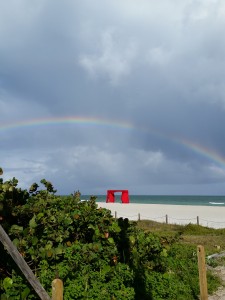
Rainbow over Art Basel Miami week at the beach.

A rainbow forms over preparations for an event at Miami Beach.

Somewhere around 41st and Collins, your Uber app would make an offer available to set sail on an Uber Boat across the bay. You and five of your friends, cocaine cowboys style.

Meanwhile around 18th and Ocean, you practically needed an Uber Boat to cross the road. Heavy downpours on Thursday night and during the day Saturday made jumping from beachside to Aqua not only treacherous but potentially ruinous to a pair of espadrilles.

The Soak

Espadrilles weren’t even safe inside the fairs. In at least one of the gargantuan fair tents, water was coming up from the beach sand around the edges and up through the seams of the plywood floors. Water ran aggressively down the inner walls.

At one booth from a Mexico City gallery, I watched large puddles of water creep from the edges – just underneath three framed underwater photographs. Had the artist thought of this playful addition, the triptych would really have been something.

Localized flooding in an art fair.

Localized flooding at one fair during Art Basel Miami week 2015.

One half of the gallery assistants didn’t see the humor right away. The other did. She laughed heartily without an effort toward addressing the influx of rainwater.

Amid the sound of wet vacs elsewhere in the fair, it was difficult to tell when the rain finally stopped. Artists, collectors, and gallerists all got soaked.

Making It Rain at NADA

NADA moved to the freshly facelifted Fountainbleau with a strong and noticeably more upscale presence. If the rainy weather outside wasn’t enough – and budget permitted – fair goers and participants could make it rain until the morning hours at LIV.

Meanwhile, Miami Project and Art on Paper moved to the aging Deauville.

All offer 18% gratuity included for your convenience.

A Cutting Edge Week for Art Basel Miami

On Friday night, the Art Basel Miami fair partially became a crime scene – or rather, an official one. An X-Acto blade is great for precision cutting and slicing, while only passable for stabbing. Anyway that’s exactly what a fair attendee used one for. There was a great deal of blood – so much so that the act was mistaken for a performance piece by those nearby.

Bloodied fair goer at Art Basel Miami 2015

Stabbing at Art Basel Miami 2015. Photo from Miami Herald.

Then there were cops, an arrest, social media posts, caution tape, the works. There was also a very thoughtfully worded statement, sensitive to the fact that travelers from around the world are now on perpetually heightened terror alert. The “isolated incident” was “immediately secured.”

In the end, it wasn’t terror or even a hate crime according to police. The alleged assailant was simply charged with attempted murder.

Interestingly, one article noted that the alleged assailant was “starting to think about applying to graduate school.”  At the time of writing, there is no news regarding the victim’s thoughts on getting an MFA.

And More Senseless Blade Violence

Blade violence wasn’t limited to the fairs during Art Basel Miami Beach weekend. The next morning on Alton Road, blocks away from the convention center and south of the gorgeous 1111 Lincoln Road parking deck, an attempted bank robbery led to police permanently “neutralizing” a man. He was armed with a barber’s straight razor.

The Surge

As a result, a portion of Alton Road was closed, further complicating a traffic situation already yielding Uber surge rates – 4.6 on one occasion in fact.

And forget that Uber Boat. If you tried to book it, the prompt always said that “all ships have set sail.”

FacebookShare

Filed Under: Contemporary Art, Culture, Featured, Travel Tagged With: Art Basel, Art Basel Week, Art Fairs, Miami, Travel

A Layover in Denver Airport’s Concourse A

October 6, 2015 By Matthew White Leave a Comment

FacebookShare
Mustang sculpture at Denver International Airport

Behold a pale horse welcomes you to the Denver International Airport. You should see it at night. Photograph provided courtesy of Denver International Airport.

I’m never without the impression that Denver International Airport is creepy. It just feels creepy. Whether its about the blue Mustang sculpture – “cursed” because it actually killed its creator Luis Jimenez – or the gargoyles in the suitcases that await you at baggage claim, it’s always been a confusing, contradictory space.

There is plenty already out there about the apocalyptic murals, the swastika-like shape of DIA’s layout, and the dedication stone “control console.” (And we’re just talking about what is visible at DIA). Therefore, I  want to focus on new observations and things I haven’t been able to find much about, situated on Concourse A.

Concourse A Central Core Sculpture

View of the sculpture in concourse A of the Denver International Airport entitled Dual Meridian.

Great view of the sculpture in concourse A of the Denver International Airport. See any pyramids, triangles, or all-seeing eyes? Look more closely. Photograph provided courtesy of Denver International Airport.

The massive sculpture in the center of concourse A – David Griggs’ Dual Meridian – is obviously exploring themes of travel, technology, and the evolution of transportation.

On this visit however, I was struck most by the poor visibility for much of the sculpture.

Two sides are arranged in such a way that the sculpture can be viewed and appreciated from those vantage points. But, visibility is painfully impaired from the two other sides situated against the flow of train traffic below. Important and costly elements are visible only from certain angles and heights, such as the stone “world map” feature of the installation.

Why is this?

For such an advanced structure in terms of engineering and architecture, wouldn’t this have been taken into consideration by the New World Airport Commission? After all, opening at $2 billion over budget, sticking to the numbers has hardly been an issue for DIA.

If viewed from certain angles, you also get some interesting geometric effects.

The Beacon

Not far away from “central core” as DIA calls it (?!) sits an unwieldy and extremely heavy artifact – presumably a beacon from aviation history. As with so much of the airport, wall texts and explanations regarding the installations and displays are sparse. I couldn’t find anything regarding this piece nearby, and my research was not productive either. Even worse, I failed to document the artifact on my last visit and have not found an image in my subsequent research.

The conspiracy theory takeaway from “The Beacon?” “Light” and the Promethean act of providing illumination to man are important themes in Illuminati symbology.

Names of continents and other texts in a DIA floor mosaic

Look closely and try to read the texts in this DIA floor mosaic.

Floor Mosaics

At first, there isn’t anything obviously sinister about the floor mosaics entitled Patterns and Figures – Figures and Patterns in Concourse A. It’s after a little study that you start to have questions.

Like Dual Meridian at the center core of the A gates, viewing and processing the floor mosaics isn’t easy. The content is severely obscured by its installation. Little of it can truly be read and absorbed from the first level.

But, take a ride higher on the escalator, and elements become more clear. Others however, not so much. Areas along the border of the mosaic are confused and hidden from that vantage point. Why? It is as if this element along with others – just as with Dual Meridian – are intended to be viewed from a much higher vantage point. And, by “much higher,” we’re looking at two to three floors higher along with the removal of some elements of existing floors.

The word "quiet" in a DIA floor mosaic

The word “quiet” and what else? Also, note the black outlines of triangles with “all seeing eye” squares. See them?

The names of continents are scattered within the mosaic, which of course makes sense thematically for an international airport. But, symbols, words, and phrases are included, much of which are difficult to decipher. Presumably, the themes would adhere to the usual cliched universal values displayed in this kind of context – such as peace, love, and understanding.

However, one word is obvious: “quiet.”

Quiet?

What is the relation of quiet, or silence, to the continents? To global travel? Why would other words and phrases be so comparatively indecipherable?

And, again, there is no wall text or accompanying information readily available for what was a significant undertaking to install. Go to the web site and you get bland and brief expository texts.

So Many Questions . . . Did They Call Zone 2?

Just as with the Georgia Guidestones, you leave the site asking even more questions. Regardless of your thoughts on conspiracy theory ties, the Illuminati, or just plain creepiness, there are some basic and reasonable questions anyone would ask: Why are there such problems with artwork display, installation, and visibility? Why would you place some of the artwork that they’ve chosen – including gargoyles, stormtroopers, and apocalyptic narratives – in this context? Is the swastika style layout really a good idea for a cluster of runways? Is it all just poor planning? Bureaucratic incompetence?

And finally, is it really true that the British monarchy owns real estate near the airport?

FacebookShare

Filed Under: Contemporary Art, Culture, Featured, Travel Tagged With: Conspiracy Theory, Contemporary Art, Illuminati, Travel

Matthew White

Multimedia artist Matthew White shares thoughts and meanderings. Subjects in the Tokens From The Well arts and culture blog include travel, creativity, contemporary art, music, culture, his work, and delightful randomness.

Let’s Connect

TheMWGallery.com on FacebookTheMWGallery.com on TwitterTheMWGallery.com on PinterestImages from the studio of Matthew White - TheMWStudio on Instagram

Search The Well

Clouding The Water

#StopInfluenceNow Activism Algorithms Algos Alternative Country Apple Art Art Auctions Art Basel Art Basel Week Art Fairs Conspiracy Theory Contemporary Art Continuing Crisis in Contemporary Art Creativity Culture Food Georgia Illuminati iMac Miami mp3 Music Nashville New Institutionalism New Orleans Outsider Art Reviews Southern Culture Streaming Studios Technology Travel

Copyright © 2026 Gamelan, LLC. All rights reserved. · XML Sitemap · Visit TheMWGallery.com